Guest article
How to Choose a Professional Laser Projector for Large Venues in Dubai
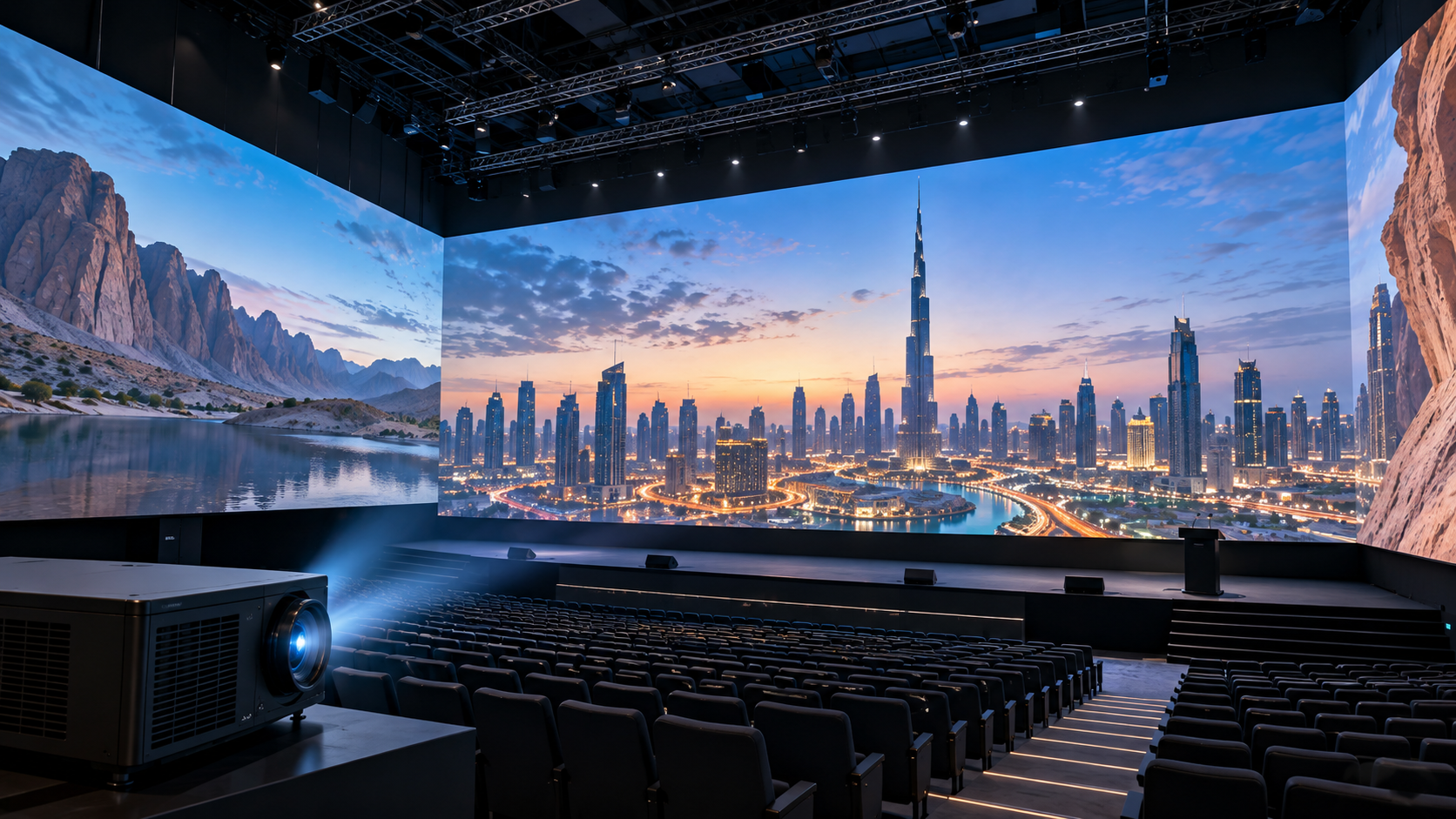
Choosing a projector for a meeting room is relatively straightforward. Choosing one for an auditorium, exhibition space, museum, hotel, event venue or immersive installation is a very different challenge.
Large venues often have bigger screens, longer projection distances, higher ambient light and more demanding operating requirements. As a result, selecting a professional laser projector in Dubai should be based on the actual environment rather than brightness or resolution alone.
Here are some of the most important factors to consider when planning a professional projection system.
1. Start With the Venue and Application
Before comparing projector specifications, first understand how the space will be used.
A corporate auditorium displaying presentations has different requirements from an immersive exhibition projecting content across several walls. Similarly, a museum installation may need to operate for long periods every day, while an event venue may require flexibility for different screen sizes and configurations.
Professional projection is commonly used in:
Auditoriums and conference halls
Museums and galleries
Exhibitions and experience centres
Hotels and hospitality venues
Corporate environments
Educational facilities
Entertainment venues
Immersive projection installations
Large meeting and presentation spaces
Understanding the application helps determine the required brightness, resolution, lens configuration and installation method.
2. Consider Brightness and Ambient Light
Brightness is one of the most important specifications for a large-venue projector.
A projector that performs well in a dark room may struggle when used in an exhibition hall, conference venue or other environment where ambient lighting cannot be completely controlled.
However, simply choosing the projector with the highest lumen figure is not always the answer.
Screen size, projection surface, viewing distance, ambient light and the type of content being displayed should all be considered when determining the appropriate brightness.
This is why professional installations should ideally be evaluated on a project-by-project basis.
3. Resolution Matters — But So Does the Content
Higher resolution becomes increasingly valuable as projection surfaces become larger.
Professional applications may use Full HD, WUXGA or 4K projection depending on the content and viewing requirements.
Detailed architectural visualisations, videos, exhibitions and immersive experiences can particularly benefit from higher resolution because viewers may be relatively close to a very large image.
The source content and AV system should also be capable of delivering the required resolution. Installing a 4K projector alone will not improve low-resolution source material.
4. Check Throw Distance and Lens Options
One specification that can easily be overlooked is the throw ratio.
The distance available between the projector and projection surface determines which lens configuration is suitable.
Some projects may require:
Standard-throw projection
Short-throw projection
Ultra-short-throw projection
Interchangeable lenses
Lens shift
Flexible zoom ranges
Large venues can also have architectural restrictions that limit where projectors can be installed.
Selecting the correct projector and lens combination during the planning stage can prevent significant installation problems later.
5. Think About Laser Projection for Professional Installations
Laser projection has become particularly useful for professional environments because it can provide high brightness, consistent performance and reduced dependence on traditional lamp replacement.
For venues that use projection frequently, this can simplify ongoing operation and maintenance.
Professional laser projectors are therefore increasingly relevant for applications where systems may need to operate for extended periods, including museums, experience centres, auditoriums and commercial installations.
6. Immersive Projection Requires More Than One Projector
Immersive environments are becoming increasingly popular across exhibitions, museums, visitor attractions and entertainment spaces.
Instead of projecting onto a single conventional screen, multiple projectors can be used to create much larger visual environments across walls or other surfaces.
These projects may require techniques such as projection blending and geometric correction so that images from multiple projectors appear as one continuous visual experience.
Projector placement, brightness consistency, resolution and system calibration become particularly important in these applications.
7. Plan the AV Infrastructure at the Same Time
A professional projector does not operate independently.
The complete system may also include video processors, signal distribution, control systems, audio equipment, networking and content sources.
Planning these elements together can help avoid issues such as insufficient cabling, incompatible signal formats or equipment being installed in unsuitable locations.
For new commercial projects, involving the AV team during the design stage can also help architects, consultants and contractors coordinate projector positions, equipment racks, power, data and structural requirements.
8. Consider Reliability and Future Requirements
Large-venue projection systems are often long-term investments.
It is therefore worth considering not only today's requirements but also how the space may be used in the future.
A venue may initially require presentations and video playback but later introduce interactive content, larger projection surfaces or immersive experiences.
Choosing professional projection equipment and infrastructure with sufficient flexibility can make future upgrades easier.
Where Appotronics Fits Into Professional Projection
For projects requiring high-brightness and professional laser projection, Appotronics provides projection solutions designed for a range of professional and large-format applications.
The portfolio includes solutions suitable for applications such as large venues, auditoriums, exhibitions, immersive environments and other professional AV installations.
In the UAE, Abode Automation provides Appotronics professional projection solutions alongside system design, projector selection and complete AV integration.
Rather than selecting a projector based only on a specification sheet, the objective should be to match the projection technology to the venue, screen, content and operating environment.
Final Thoughts
There is no single projector specification that is suitable for every large venue.
Brightness, resolution, ambient light, projection distance, lens selection, operating hours and AV infrastructure all influence the final result.
For architects, consultants, developers and venue operators planning a professional projection system in Dubai or the UAE, considering these requirements during the early design stages can lead to a more reliable and flexible installation.