Guest article
Termite Treatment in Dubai: Methods, Process and Cost
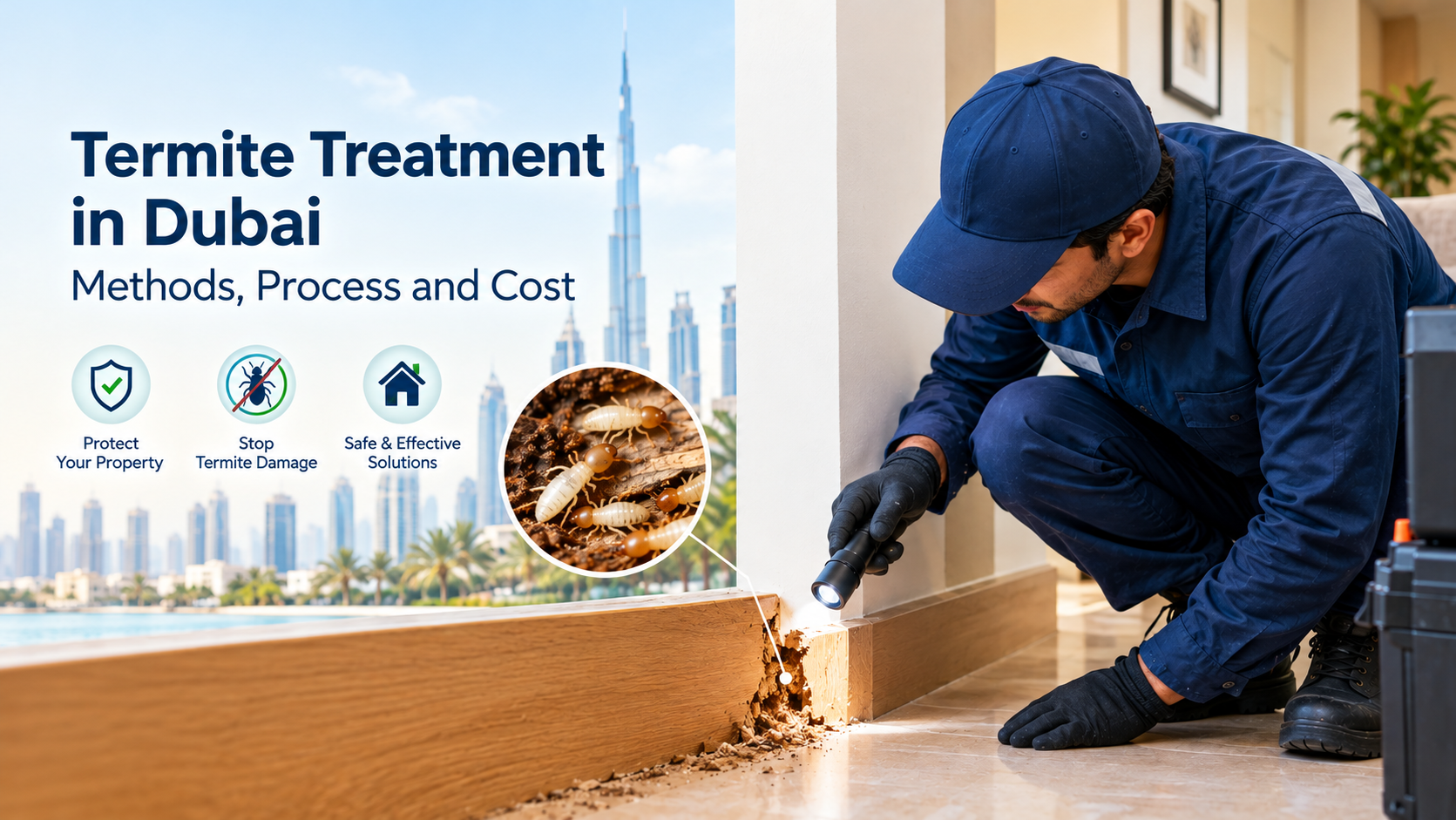
Termites can cause significant damage to wooden doors, cabinets, flooring, skirting boards, and other parts of a property before homeowners even realise there is an infestation. In Dubai, where villas, townhouses, and apartments feature a wide range of wooden fixtures and concealed building spaces, early termite detection and appropriate treatment are essential for protecting your property.
Unlike many common household pests, termites often remain hidden inside wood, beneath floors, or behind walls. Spraying visible insects may not address the underlying colony, allowing the problem to continue even when the signs temporarily disappear.
Professional termite treatment in Dubai involves identifying the termite species, locating the source of the infestation, selecting a suitable treatment method, and taking steps to reduce the risk of recurrence.
This guide explains the main termite treatment methods, what happens during a professional service, how much treatment may cost in Dubai, and how you can protect your property from future infestations.
Why Is Termite Treatment Important in Dubai?
Dubai's warm climate, landscaped residential communities, irrigation systems, and occasional moisture problems can create conditions that support termite activity. However, the risk depends on several factors, including termite species, soil conditions, building design, wood availability, and moisture levels.
Termites can enter properties through soil, cracks, construction joints, gaps around utility pipes, and other concealed access points. Once inside, they may feed on suitable cellulose-containing materials, including wood and some paper-based products.
Common areas vulnerable to termite damage include:
Wooden door frames and window frames
Built-in wardrobes and kitchen cabinets
Wooden flooring and skirting boards
Furniture and timber fixtures
Concealed wooden structural components
Areas around plumbing leaks and damp building materials
Termite damage can remain hidden for months or longer. By the time visible signs appear, affected wood may already have lost strength or require replacement.
Professional inspection helps identify the likely termite type, assess the extent of the infestation, and determine whether localised treatment or a broader protective barrier is necessary.
What Are the Signs That Your Property Needs Termite Treatment?
Recognizing early warning signs can help you arrange an inspection before the damage becomes extensive.
1. Mud Tubes on Walls or Foundations
Subterranean termites build narrow mud tubes to travel between their underground colonies and food sources while maintaining a protected environment. These tubes may appear along walls, foundations, skirting boards, or other surfaces.
Do not assume that removing the visible tubes eliminates the infestation. The colony may still be active elsewhere.
2. Hollow-Sounding or Damaged Wood
Termites often consume wood from the inside, leaving a thin outer layer intact. Wooden doors, cabinets, or skirting boards may therefore sound hollow when tapped or show unexpected deterioration.
Soft, damaged, blistered, or crumbling wood should be inspected to determine the cause.
3. Discarded Wings Near Windows
Winged termites, known as swarmers or alates, may emerge to establish new colonies. After swarming, they can shed their wings, which may accumulate near windows, doors, and light sources.
Discarded wings are a warning sign worth investigating, although identification is important because flying ants can look similar.
4. Bubbling Paint or Unexplained Surface Damage
Termite activity beneath a surface can sometimes cause paint to blister or wood finishes to appear damaged. However, moisture intrusion, poor adhesion, and other building problems can produce similar signs.
A professional inspection can help distinguish between these possible causes.
5. Repeated Damage to Wooden Fixtures
If door frames, wardrobes, or other wooden fixtures repeatedly show signs of deterioration, investigate the cause rather than simply replacing the affected material.
Replacing damaged wood without addressing an active termite infestation may leave the property vulnerable to further damage.
What Are the Main Termite Treatment Methods in Dubai?
The appropriate termite treatment depends on the species, location of the colony, extent of the infestation, building construction, and accessibility of affected areas. There is no single method that is suitable for every property.
1. Liquid Termiticide and Soil Barrier Treatment
Liquid termiticide treatment is commonly used to manage subterranean termites. The objective is to create a treated zone in the soil around or beneath vulnerable parts of a building, reducing the ability of termites to reach the structure.
For existing buildings, a technician may need to treat the soil around the foundation and selected areas beneath concrete floors. Depending on the property, this can involve carefully drilling access holes, injecting the approved product, and sealing the openings afterwards.
Best suited for: Properties with subterranean termite activity where soil treatment is appropriate.
Advantages:
Can create a protective treated zone around vulnerable areas
Addresses termite access routes rather than only visible insects
Can be used in selected existing buildings as well as new construction, with different application procedures
Considerations:
The property may require drilling or other access work
The effectiveness depends on correct application and continuity of the treated zone
The treatment must be selected and applied according to the product label and site conditions
2. Termite Baiting Systems
Baiting systems use stations containing a cellulose-based material and a termite-active ingredient. Foraging termites feed on the bait and may transfer it to other colony members.
The stations are monitored over time, and bait is replenished or adjusted as required. Unlike a one-off spray, a baiting programme generally involves ongoing inspections and maintenance.
Best suited for: Selected infestations where monitoring and gradual colony suppression are appropriate, or where extensive soil treatment may be impractical.
Advantages:
Can target termite colonies through foraging behaviour
May reduce the need for extensive drilling
Provides a way to monitor ongoing termite activity
Considerations:
Results may take time
Stations must be placed and monitored correctly
The initial installation and ongoing monitoring may involve separate charges
3. Localised Wood Treatment
When termites are confined to identifiable areas, such as a door frame, cabinet, or accessible timber component, a technician may use a suitable direct-treatment method.
Depending on the product and the construction, treatment may involve applying a termiticide to exposed wood or injecting an approved formulation into affected galleries or voids.
Best suited for: Localised infestations where the affected timber and likely activity can be accessed.
Advantages:
Targets specific affected areas
May reduce the need for extensive treatment elsewhere
Can be useful as part of a broader treatment plan
Considerations:
Treating visible damage alone may not eliminate a colony located elsewhere
Heavily damaged timber may need repair or replacement
A broader inspection is important when the infestation's full extent is unclear
4. Pre-Construction Anti-Termite Treatment
Pre-construction treatment is applied during building work, before selected foundations or concrete slabs are completed. Depending on the design and applicable requirements, treatment creates a protective zone beneath or around the structure.
This stage can provide access to areas that become difficult to reach once the building is complete.
Best suited for: New construction and qualifying building projects.
Advantages:
Treats accessible soil before it is covered by concrete
Can help reduce the risk of subterranean termites entering through vulnerable areas
Can be integrated into the construction process
Considerations:
Timing and application must be coordinated with the construction schedule
The treatment needs to follow the approved specifications for the project
Documentation and inspection requirements should be confirmed with the contractor and relevant authorities
5. Fumigation for Specific Termite Infestations
Fumigation may be appropriate in certain cases involving drywood termites, which can live within timber without depending on contact with soil in the same way as subterranean termites.
Whole-structure fumigation is a specialised procedure requiring suitable site assessment, trained professionals, and strict safety controls. It is not automatically necessary for every termite infestation.
Best suited for: Selected drywood termite infestations where the species, spread, and building conditions justify fumigation.
Considerations:
The property may need to be vacated for the period specified by the service provider and product requirements
Re-entry must only occur after the required safety clearance
Fumigation does not repair damaged wood or automatically prevent future termite entry
A qualified professional should determine whether fumigation, direct timber treatment, soil treatment, or a combination of approaches is appropriate.
Termite Treatment Methods Compared
Method | Most suitable for | Important consideration |
|---|---|---|
Liquid soil barrier | Suitable subterranean termite infestations | Correct coverage and application are essential |
Baiting systems | Targeted colony suppression and monitoring | Requires ongoing monitoring |
Direct wood treatment | Accessible, localised timber infestations | May not address a separate colony elsewhere |
Pre-construction treatment | New buildings and qualifying construction work | Must be completed at the appropriate construction stage |
Fumigation | Selected drywood termite cases | Requires specialised safety procedures |
The right choice should be based on inspection findings rather than price alone.
What Is the Process of Professional Termite Treatment?
Although the details vary by method, professional termite treatment generally follows several steps.
Step 1: Property Inspection
The technician examines areas where termite activity is suspected, including wooden fixtures, skirting boards, accessible foundations, utility entry points, and areas with signs of moisture.
The objective is to identify evidence of activity and determine which areas need further investigation.
Step 2: Identification and Assessment
The treatment plan depends on the termite type and the extent of the problem. Subterranean termites and drywood termites may require different approaches.
The technician should explain the likely source of the infestation, affected areas, proposed treatment, and any limitations.
Step 3: Quotation and Treatment Plan
Before work begins, ask for a clear quotation covering the proposed method, areas to be treated, preparation requirements, follow-up visits, and any warranty or re-treatment conditions.
For larger properties, the quotation may depend on the building footprint, foundation access, and extent of the affected areas.
Step 4: Property Preparation
Depending on the treatment, you may need to clear access to affected areas, move furniture, protect food and utensils, or keep children and pets away from the work zone.
Follow the technician's specific instructions rather than assuming every treatment has the same preparation requirements.
Step 5: Treatment Application
The technician applies the selected treatment according to the product label and the property's conditions. This may involve soil treatment, bait station installation, or direct treatment of affected timber.
For drilling and injection work, confirm how openings will be sealed and whether any finishing repairs are included.
Step 6: Follow-Up and Monitoring
Some treatments require a follow-up inspection, monitoring visits, or additional applications. Baiting systems, in particular, depend on continued monitoring.
Ask how progress will be assessed and what to do if you notice fresh mud tubes, damaged wood, or other signs of activity after treatment.
Step 7: Prevention and Repair
Finally, address conditions that may increase the risk of future termite activity, such as persistent leaks, poor drainage, or unsealed entry points.
Damaged wood may require repair or replacement independently of the pest control work.
How Much Does Termite Treatment Cost in Dubai?
The cost of termite treatment in Dubai depends on the size of the property, termite species, infestation severity, selected treatment method, accessibility, and any follow-up requirements.
As a rough budgeting guide based on publicly advertised UAE provider estimates, prices may fall within the following ranges. These are indicative market estimates, not fixed rates or a Care N Clean quotation.
Treatment type | Indicative cost in AED |
|---|---|
Localised wood or spot treatment | AED 400–1,500 |
Treatment for an apartment or smaller property | AED 500–1,500 |
Soil barrier treatment for a villa | AED 1,000–3,500+ |
Initial installation of a baiting system | AED 1,500–4,000+ |
Specialised whole-structure fumigation | AED 3,000–8,000+ |
Actual quotations may fall outside these ranges. The categories also overlap because providers price different scopes of work, and some estimates include inspections, monitoring, or warranties while others do not.
How Long Does Termite Treatment Last?
There is no single duration that applies to every termite treatment.
The longevity of a soil treatment depends on the product used, application quality, soil and site conditions, and the manufacturer's instructions. Baiting systems require ongoing monitoring and maintenance, while direct timber treatments have different limitations.
A warranty period is not necessarily the same as a guarantee that no termites can return for that entire period.
Before booking, ask the provider how long the treatment is expected to remain effective, whether follow-up inspections are recommended, and what happens if termite activity returns within the warranty period.
Is Termite Treatment Safe for Children and Pets?
Professional termite treatment can be carried out with appropriate safety controls, but no treatment should be assumed to be harmless simply because it is described as low-odour or family-friendly.
Safety depends on the product, application method, concentration, exposure, and compliance with the product label.
To prepare your household:
Follow all instructions provided by the technician.
Remove or protect food, utensils, and pet supplies as instructed.
Keep children and pets away from treated areas for the specified period.
Follow any ventilation and re-entry requirements.
Do not touch treated surfaces or bait stations unless instructed to do so.
If fumigation is required, follow the evacuation and re-entry instructions exactly.
How to Prevent Termites After Treatment
Professional treatment addresses the identified infestation, but prevention remains important.
Fix Leaks and Moisture Problems
Repair leaking taps, pipes, and other plumbing issues. Make sure drainage directs water away from vulnerable parts of the building where possible.
Moisture is not the sole cause of termite infestations, but persistent damp conditions can contribute to risk.
Seal Potential Entry Points
Ask a qualified professional to inspect suitable cracks, construction joints, and gaps around pipes or cables. Seal them where appropriate without interfering with necessary drainage, ventilation, or building systems.
Inspect Wooden Fixtures Periodically
Check door frames, skirting boards, cabinets, and other timber components for mud tubes, hollow areas, discarded wings, or unexpected damage.
Keep Outdoor Areas Maintained
Avoid unnecessary wood-to-soil contact, remove discarded timber, and address persistent moisture around the building. Where practical, maintain visibility of vulnerable foundation areas so signs of activity are easier to spot.
Arrange Further Inspection When Needed
If you notice renewed activity after treatment, contact the service provider and refer to your treatment records or warranty terms. Do not assume that applying a household insect spray will resolve the underlying issue.
Final Thoughts
Termite treatment in Dubai involves more than eliminating the insects you can see. Effective control starts with identifying the termite type, understanding how it is entering or affecting the property, and choosing an appropriate treatment method.
Soil barriers, baiting systems, direct timber treatment, and specialised fumigation each have specific uses. The final cost depends on the work required, so compare detailed quotations rather than relying on a generic price estimate.
If you have noticed signs of termites or want to investigate a potential infestation, start with a professional assessment and a clear treatment plan. For help exploring your options, explore Care N Clean's termite treatment service and review the available booking details.